The Parish of CALVERLEY-WITH-FARSLEY is referred to in the Domesday Book (1086) as a Manor held by the Saxon - Archill. When the Norman Conquest was over and William gave land away to his noblemen, the area formed part of the estate of Ilbert de Lacy.
Recorded in 1086 is the following -
"In Calverlei and Ferselleia, Archill had three carucates of land to be taxed (a carucate was as much land as a team of oxen could plough in a season), and there may be two ploughs. Ilbert has it and it is waste. Value in King Edward's time, twenty shillings. Wood pasture half-a-mile long and half broad".
I would assume here that due to the conquest the area would be somewhat de-populated. Archill and his son Gospatric kept some of their property under a Norman over-lord and retained this portion of it in Calverley in his family until the middle of the 12th Century. Gospatric also had "two carucates in Brameleia".
FARSLEY
In 1086 it was FERSELLEI(A). Anglo-Saxon names are quite common in the area such as Bramley and Rodley. The 11th Century changed the village name slightly to FERSLEE - FERSELAY - FERSELEY - FERSLEG - FERSELAYA - it looks as if they could not make up their minds at the time. Later in the 12th Century it was changed to FIRSLAY and in 1349 it was shown as FARSELAY and in 1422 it became FARSLEY and eventually our present spelling of FARSLEY.
It has been suggested that the word originates out of the Old English "FYRS" - furze or gorse linked with "LEAH" - a lea or meadow, pasture or open country. The village in those bygone days had perhaps been a small settlement in "a clearing with gorse bushes".
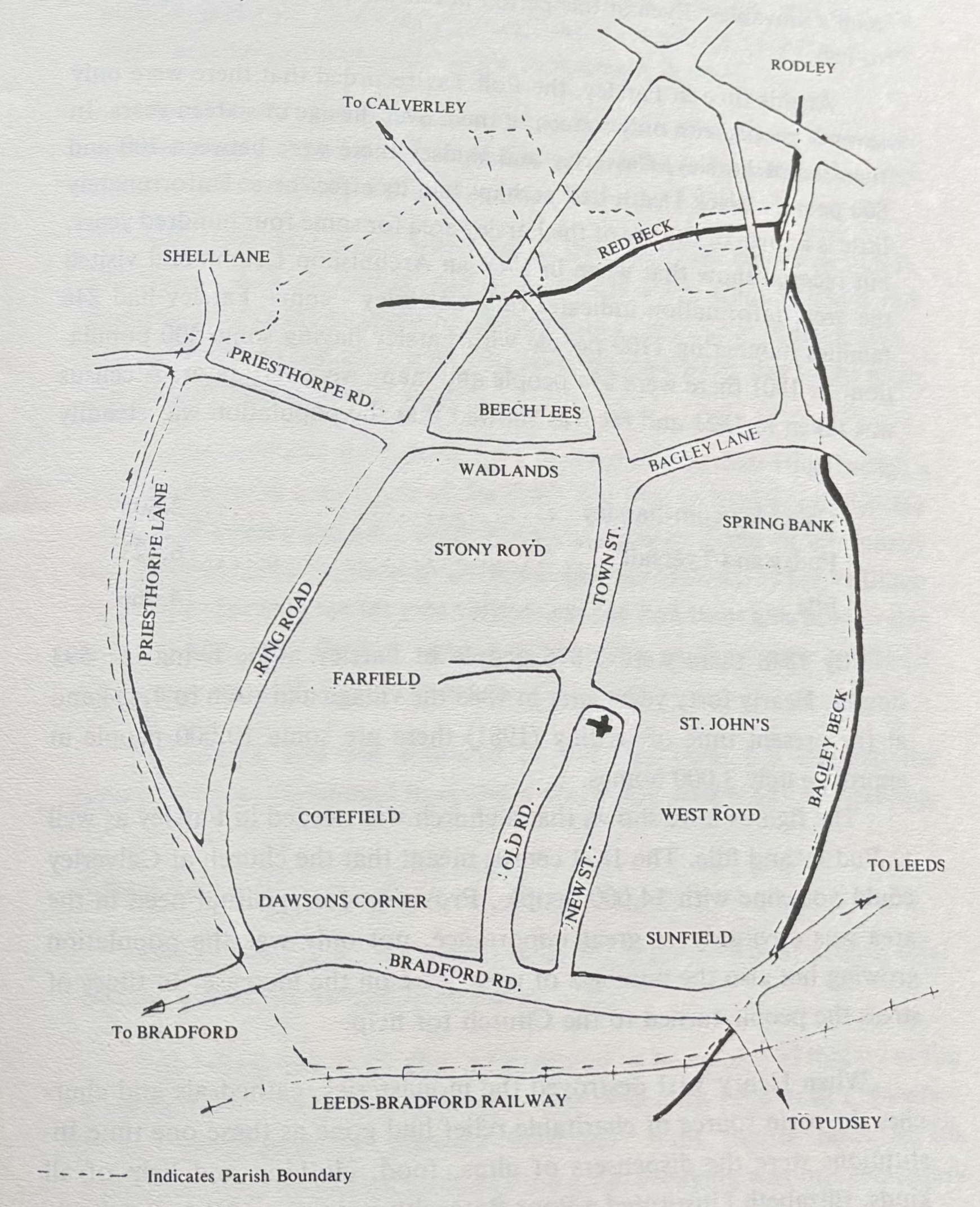
Since the church was built and Farsley became a Parish, the boundary was formed entirely by Priesthorpe Lane and the beck which ran near the old Bradford Road down by Stanningley Ironworks and on by Beckbottom to the Leeds boundary at Bagley.
PARISH OF FARSLEY
"The boundaries are formed almost entirely by Priesthorpe Lane and the beck which runs near the Bradford Rd., down by Stanningley Ironworks and Beckbottom to the Leeds boundary at Bagley".
(March 1900)