Ten years after the Black Death had taken its devastating effect on the country's population (1349 and 1369 outbreaks) a Poll Tax was taken over the whole country (1379). This was a tax of "so much per head" and was levied on an area i.e. a fifteenth on a county and a tenth on a town. It was a direct taxation of the population and these two figures were originally a fractional part of a man's movables. Even at this period in our history it was a difficult tax to levy.
At this time in Farsley, the Poll Tax recorded that there were only seventy people with only sixteen of them over the age of sixteen years. In the area of Farsley, Calverley and Pudsey there were between 700 and 800 people. Black Death had perhaps had its effect here. Unfortunately, little is known of the life of the Farsley area for some four hundred years, but records show that when in 1764 an Archbishop Drummond visited the area, information indicates that Calverley - cum - Farsley had 346 families numbering 1100 people with Farsley having some 400 population. In 1801 there were 954 people and many were very poor. A census was taken in 1821 and records showed that the population was steadily growing:
-
Calverley-cum-Farsley..... 2,605
-
Pudsy and Tyersall..... 6,223
-
Idle..... 4,666
By 1848 there were 2,876 people in Farsley alone living in 593 houses. Nearly forty years later in 1885 the village had risen to 4,434 and at the present time of writing (1981) there are some 10,000 people in approximately 3,000 homes.
The figures have shown that a church was needed in Farsley as well as Pudsey and Idle. The 1821 census meant that the church at Calverley could not cope with 14,000 people. Provision for spiritual need in the area was obviously of great importance, not only was the population growing but also the numbers of poor were on the increase. In times of stress the people turned to the Church for help.
When Henry VIII destroyed the monasteries, cathedrals and churches the main source of charitable relief had gone as these one time institutions were the dispensers of alms, food, clothing and help of all kinds. Elizabeth I instituted a Poor Rate with overseers of the poor being provided and were often referred to as Parish Officials. An example of this in Farsley happened in 1711 when a payment of fourteen shillings was made to an apprentice – James Gawthorpe "in lieu of the chest left to him by his mother," being sold by James Walker who was a overseer at the time for the poor of Farsley. The only way that money could be raised in a parish was through "a taxation of every inhabitant", very difficult due to the numbers of the poor people. These "inhabitants" were in fact owners of houses and land etc. The sums of money needed were used in different situations and one was "the setting to work of all children whose parents were unable to maintain them."
In 1834 the Poor Law Amendment Act was introduced which allowed many parishes to organise emigration schemes paying the passages of emigrants out of the poor rates.
You may think that "what has all this got to do with a church in Farsley, as well as Pudsey and Idle?" Calverley Church could not continue to support so many parishioners and the vicar at the time, Rev. Samuel Redhead had quite a task on his hands in Farsley due to the large number of "less well-off people".
Pudsey and Idle were to be more easily provided than Farsley with a church. After the conclusion of the European War in 1815 a considerable amount of money had been received by our country. Some of this money was devoted to the erection of churches and were known as the "Million Churches" in other words one million pounds had been allocated to this project. Idle and Pudsey were provided for as they were "District Chapelries to the Mother Church of Calverley".
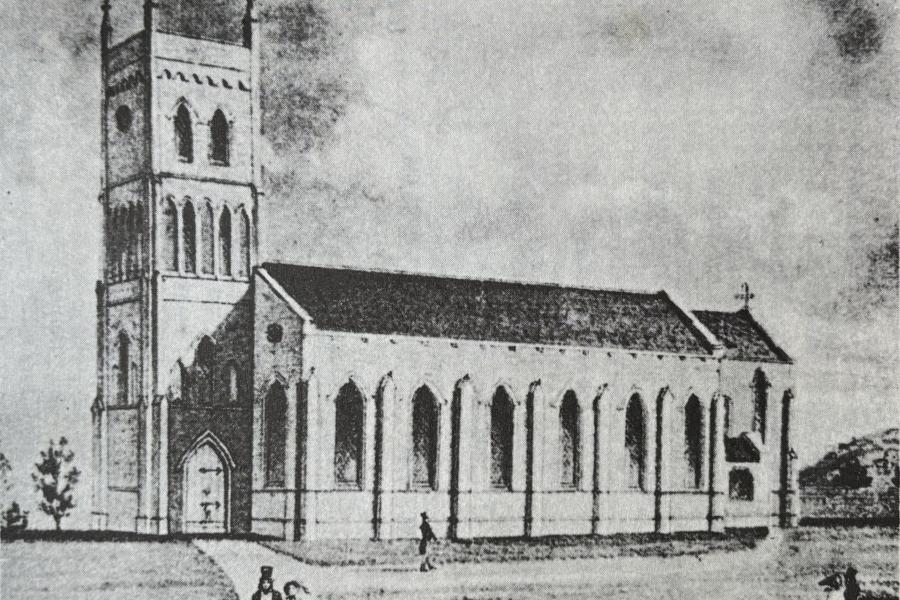
St. John's was not financed out of this fund, but through the untiring efforts of Samuel Redhead it was made possible, as we shall see.